
If you have HD, your children have a 50% chance of inheriting it. But that coin flip can be eliminated — before the next generation is born. Here is what...
The question arrives differently for different families. For some it comes after a parent's diagnosis — a sudden, terrible realization. For others it arrives after years of watching a grandparent decline, wondering if the same future is written in their own DNA.
Is this in me? Will I pass it to my children?
These are the most important questions a family can ask. And the answers, while hard, are clearer than most people realize.
How HD Is Inherited
Huntington's Disease follows an autosomal dominant inheritance pattern. This means:
- Only one copy of the mutated gene is needed to cause disease
- Each child of an affected parent has exactly a 50% chance of inheriting the mutation
- The 50% applies to every pregnancy, independently — it does not average out across siblings
- Men and women are equally likely to inherit and pass the gene

The Hardest Part: Timing
Most people with HD develop symptoms between ages 30 and 50. This means the gene is often passed to children before the parent knows they carry it.
A person born in 1975 might not develop symptoms until 2015. By then, their children — born in 1998, 2001, 2004 — are already adults. Already potentially carrying the same future.
"This is the particular cruelty of HD. It is invisible during the years when families are being built. And by the time it announces itself, the next generation has already been born."
This is also why genetic testing is one of the most personal decisions an HD family faces.
Genetic Testing: The Options
Predictive Testing (for adults at risk)
Any adult who has a parent with HD can choose to undergo predictive genetic testing. A blood test reveals whether they carry the expanded HTT gene — and therefore whether they will develop HD.
There is no obligation to test. Many at-risk individuals choose not to know. That is a valid and deeply personal decision, and genetic counselors are trained to support both paths without judgment.
Testing During Pregnancy (prenatal testing)
For couples who are pregnant and know one partner carries the HD gene, two options exist:
- Prenatal testing — tests the fetus directly. If the test reveals the fetus carries the expanded gene, the couple faces a difficult decision.
- Non-disclosure testing — tests the fetus without revealing whether the parent carries the gene, preserving the parent's right not to know their own status.
IVF with Preimplantation Genetic Testing (PGT-M)
This is the option that NVforHD funded for Brandon and Rylee Puccini in 2024 — and the one that changes everything.
With IVF and PGT-M, embryos are created and tested before implantation. Only embryos without the expanded HTT gene are transferred. The result: a child who is completely, definitively HD-free.
The HD stops here. With that generation.
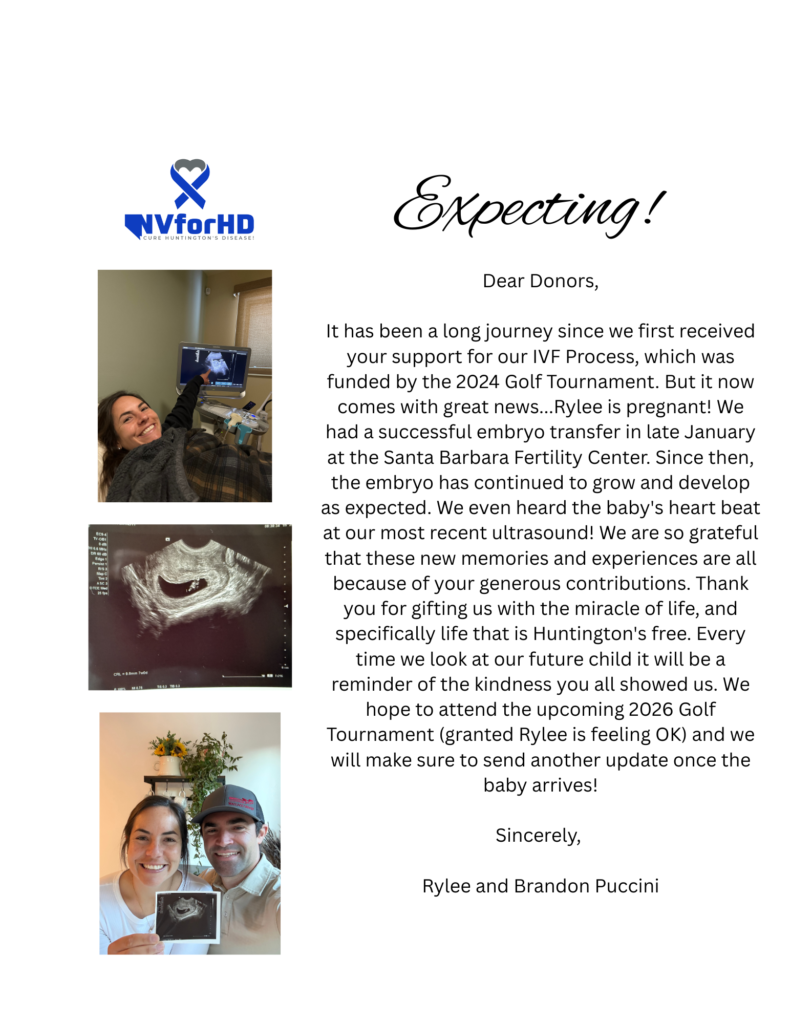
Read the full Puccini story — what $25,000 from a golf tournament made possible.
The Cost Problem
IVF with PGT-M typically costs between $15,000 and $25,000 per cycle, not including medications. Insurance coverage is inconsistent and often denied.
This is the barrier that HelpCureHD — NVforHD's 2024 charity partner — was built to remove. They provide grants to families in genuine financial need who carry the HD gene and want to pursue IVF.
NVforHD raised $25,000 at the 2024 tournament. HelpCureHD put that money toward the Puccini family's IVF journey.
What Northern Nevada Families Should Do
Step 1: Connect with a genetic counselor. The UC Davis HD Center of Excellence in Sacramento — NVforHD's 2025 and 2026 beneficiary — has an HD genetic counselor on staff. They serve Northern Nevada families. They are the right first call.
Step 2: Know your options before you need them. Families who know the IVF option exists are in a completely different position than families who discover it too late.
Step 3: Consider disclosure carefully. Testing is a gift — but it is a heavy one. Do not undergo predictive testing without counseling support.
The UC Davis HD Center serves the 90+ Northern Nevada families navigating exactly these questions. NVforHD funds their operation.
Join us May 29 — one round of golf keeps this clinic running for the families who need it.